


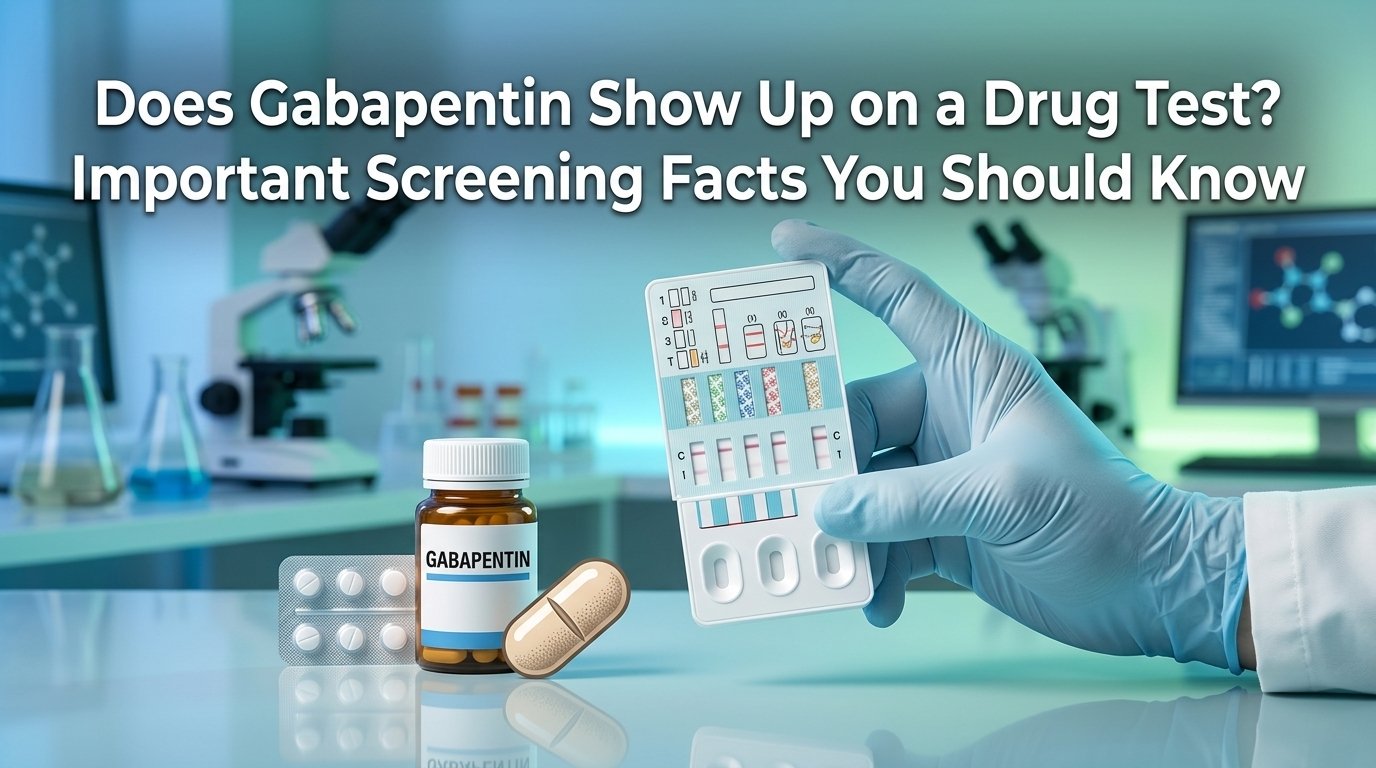
But if your doctor has prescribed you gabapentin, and you have a drug screen scheduled in the near future, you may be asking yourself: Will gabapentin show up on a drug test? Unfortunately, this is a complicated question, with the answer depending on the kind of test being conducted.
Gabapentin is a medication that comes by prescription and used to treat a variety of medical issues, such as a specific kind of nerve pain and some kinds of seizures. Gabapentin is not commonly tested for in most drug screens, which generally focus on common drug screening panels. But a laboratory can test for the presence of gabapentin specifically for medical, monitoring, legal, or other reasons.
Why it is important to know This is important because a simple drug screen test and a prescribed or medication test are not the same. Knowing the difference can help you see what the test is looking for, why a doctor might order an additional test and what to do if you are using gabapentin legally.
Does Gabapentin Show Up on a Drug Test?
How long does it take to be seen in a drug test Gabapentin is not typically detected on a drug test unless a test designed to detect it is ordered. Standard drug testing panels screen for specific drugs and not all prescription drugs are tested in standard panels. Typical urinalysis drug testing panels include testing for amphetamines, cocaine, marijuana, opiates, benzodiazepines, and several other drug classes.
The specific medications tested on the panel used may vary depending on your employer, healthcare provider, laboratory, drug treatment program, or other testing organization.
Gabapentin is not detected on a general test and is only detected with specific testing ordered by a healthcare provider.
So there are two separate questions:
- Will gabapentin be detected if the laboratory is specifically testing for it? Yes, a test can be designed to detect the medication.
- Will it automatically be detected on every routine drug screen? No.
The test order is therefore just as important as the medication itself.
Why Standard Drug Panels May Not Include Gabapentin
Not all drugs show up on every test. The analytes listed on each panel are chosen for testing because of the intent of the screening.
For instance, a workplace screening program might test for an arbitrary list of substances that tend to be used by an identifiable population. An individual with a pain problem may be asked to undergo a longer drug panel test. A laboratory can also perform more detailed testing if it turns out you are being tested for one specific drug.
The American Academy of Family Physicians has explained: The reason various drugs need to be tested for in different ways is that many of the commonly used immunoassay testing methods cannot reliably detect all drugs of interest.
Tests that are performed in a laboratory can detect different drugs or drug metabolites with much greater specificity.
That is what is meant by “drug test”; two people going to the same collection site may be tested for completely different substances.
Routine screening versus medication monitoring
A typical screening panel usually answers a question of whether the drug classes have been identified. Medication monitoring may pose a question of whether the drug the patient is prescribed is present in the sample as expected. At that time, the drug may be included in the orders to the laboratory specifically. The point is really important for patients on several medications; a negative result on a typical panel does not automatically mean that all of the patients medications are absent.
What Kind of Test Can Detect Gabapentin?
How can gabapentin use be tested? Laboratory testing can be performed on drugs such as gabapentin. Urine testing is often used for drug testing as it is simple to collect and generally provides a reasonable window of detection for drug testing. Other sample types, such as blood, hair or saliva, are also used for some drug testing but this will depend on what is being tested for.
Urine testing
Testing for substances in the urine is so important for medication monitoring because gabapentin, like many other drugs, is cleared from your body through the kidneys. According to the FDA label for gabapentin, it “is eliminated by renal excretion as unchanged drug rather than being extensively metabolized”. A test for gabapentin specifically, which can be ordered, should be able to identify whether or not you have it in your system or you have levels that are above the laboratory’s reporting levels.
Blood testing
This is a blood test that can give drug levels if there are situations when it can be clinically informative to have a blood level. This is not the same as a workplace drug test urine screen so don’t assume it is for the same purpose or has a similar window of detection.
Specialized laboratory testing
Other testing procedures can detect specific drugs more precisely than standard immunoassay screening. Laboratory confirmation tests identify individual drugs instead of just screening for a drug class. If you doctor is only concerned if gabapentin is present, the lab can choose a test to determine this rather than a default panel test.
Can Gabapentin Cause a False Positive?
A common concern is, “Will I test positive for another drug if I take gabapentin?”The interpretation of a routine screening result depends on the testing method. When confirmed, a positive immunoassay screening result should be validated by more specific confirmatory testing when necessary. –American Academy of Family Physicians.
This means you should not automatically assume that an unexpected positive result was caused by gabapentin.
If a screening result does not make sense, the useful next step is to ask:
- What substances did the original panel test for?
- Was gabapentin specifically included?
- Was the result a preliminary screening result or a confirmed laboratory result?
- Is additional testing available to identify the substance more specifically?
- Have all current prescriptions, over-the-counter medicines, and supplements been reported?
The exact circumstances matter. A screening test is not always the final word, particularly when the result has important medical, employment, legal, or treatment consequences.
How Long Does Gabapentin Stay in the Body?
People want to know about the “detection time” of Gabapentin, but there’s no single number that applies to everyone. The drug is eliminated in part by the kidneys, making renal drug clearance relevant to its detection. The FDA labeling indicates it has an elimination half-life of about five to seven hours in adults with normal renal function, while elimination is significantly extended in patients with severe renal impairment. That doesn’t mean a drug test will identify Gabapentin for that exact period of time.
A laboratory’s detection window can depend on factors such as:
- The type of specimen collected
- The specific analytical method
- The laboratory’s cutoff or reporting threshold
- How frequently the medication is taken
- The dose prescribed
- Kidney function
- The time between the last dose and sample collection.
- Individual differences in drug elimination
Because of these variables, online claims promising an exact number of days should be treated cautiously.
Kidney function matters
On the other hand, gabapentin is distinct because the drug is not significantly metabolized by the liver. It is primarily excreted unchanged through the urine.The FDA label specifically states that clearance declines as renal impairment worsens and dosage reductions are recommended for patients with impaired renal function.
In other words, two patients taking the same dose might not clear the medication at the same rate.
One person with compromised renal function might still have gabapentin in his or her system long after someone with normal renal function has eliminated it. That’s why doctors take renal function into account when writing prescriptions for this drug.
Why Would a Doctor Test for Gabapentin?
When might a clinician order medication-specific testing? Medication-specific testing isn’t intended to prove drug abuse on the part of the patient. Sometimes, testing may be part of prescription monitoring. The clinician might want to confirm the medication that they’ve prescribed is present, or they want to confirm adherence, or the medication would be part of the patient’s broader medication profile.
This may be especially the case when the patient is taking multiple medications that impact the nervous system, or may be relying on information that the physician might use in their evaluation prior to treatment.
In some cases, this may also include testing for other substances. The doctor may wish to know, for example, if the patient’s on other medications that can cause interactions, or if there are other substances in the patient’s system that can pose risks. The interpretation of any testing in context can only be done by the clinician.
A Positive Result Does Not Automatically Mean Misuse
Presence of gabapentin in a sample is not necessarily proof of abuse. If the individual has a valid prescription for the medication and uses it as directed, its presence may be expected.Conversely, a negative test is not necessarily proof that the individual has not taken this medication, as testing results can be affected by timing, specimen type, laboratory processing, dose, compliance, and other issues. As is true for all drug testing, results must be interpreted in the context of the patient’s medication history and the goal of the test.
What Should You Do Before a Drug Test if You Take Gabapentin?
What Should I Do If I Have Been Prescribed Gabapentin If you have been prescribed Gabapentin, the safest course of action is usually to administer the medication as instructed, instead of changing your medication schedule just because you are taking a test. Don’t stop taking Gabapentin without consulting your doctor. For some reasons a medication is prescribed, stopping it suddenly can create issues, though how this is handled will be different for every individual. Ensure that if you are undergoing a test which requires disclosure, the administrator knows everything that you are taking before the testing.
A practical preparation checklist is:
- Keep a current medication list. Include prescription medicines and other products the testing provider asks you to report.
- Tell the appropriate healthcare professional that you take gabapentin. This provides context if the medication is included in the testing.
- Follow your normal prescription instructions.Do not alter the prescribed dose simply to influence a test.
- Ask what type of test is being performed if you are unsure. The name of the panel can clarify what substances are being assessed.
- Ask about unexpected results. If a result conflicts with your medication history, ask whether confirmatory testing is appropriate.
There is generally little benefit in trying to manipulate a legitimate medication test. The more useful strategy is accurate medication disclosure and proper interpretation.
Common Mistakes People Make About Gabapentin and Drug Tests
One of the biggest errors to make is to assume that each drug test will detect a certain medication. It will not. A second error is to assume that because you had a standard panel result that was negative that you can’t be detected for gabapentin, but being tested specifically for gabapentin is different.
Making the mistake of thinking that you can base your detection on the half-life of a medication is a mistake as well, because the half-life only measures how long the body takes to eliminate a drug, it does not predict when the lab tests specifically for that drug.
Confusing gabapentin and pregabalin is another common misconception in that the two are not the same medication, but they do sometimes have overlapping tests. You may think that a positive screening test is conclusive, but a screening test does have some degree of error, and a negative result does not necessarily mean that you weren’t exposed to that particular drug.
Does the Type of Drug Test Change the Answer?
Yes. The type and purpose of the test are central to understanding medication testing.
| Test situation | Is gabapentin necessarily included? |
| Basic workplace drug panel | Usually not |
| Standard urine drug screen | Not necessarily |
| Expanded medication-monitoring panel | Possibly |
| Gabapentin-specific laboratory test | Yes, if the test is designed for it |
| Blood test ordered specifically for gabapentin | Yes |
| Broad toxicology testing | Depends on the laboratory’s analytes |
The exact panel should always be checked rather than inferred from the phrase “drug test.”
For example, a workplace screening program may use a defined panel intended to identify selected drugs of concern. A healthcare provider monitoring prescription use may order a different panel that includes specific medications.
Laboratories also have different reporting capabilities and cutoff thresholds. That is why two tests performed on similar specimens can produce different information.
What If You Are Worried About a Drug Test Result?
If you have a valid prescription and worried about the way the drug will appear, ask the person performing or interpreting the test. Keep your prescription proof if relevant. If you get an unexpected result, ask for an explanation instead of trying to explain it on your own.
If you ask whether the lab tested for gabapentin, you can also ask whether this was done by initial screening or more sensitive confirmatory testing.
For medical tests, your doctor or prescriber may be able to interpret the test result in the context of your dose, time since last dose, kidney function, and history of medication use. If the test is for employment, legal, probation, or other reasons that can have serious consequences, the program or legal context may set different rules for drug testing than a general consumer might expect from web sources.
When Should You Talk to Your Doctor?
But it is definitely something to discuss with your prescriber if you are thinking of switching from or stopping a gabapentin medication because of a drug test. Gabapentin is a medication, and Mayo Clinic says it is used for several conditions, including the following: The medication can have side effects, including unsteadiness and clumsiness, cognitive problems, dizziness, drowsiness, fatigue, and more. Your doctor can tell you why you are taking it and whether it will be monitored and whether any changes are appropriate.
If a drug test gives a result you did not expect, talking to your doctor or other prescriber may help, as they can check a laboratory report, medication history, timing of doses, and other factors.
Most important, avoid taking any action involving prescribed medication that could change a drug test result without getting medical consultation first.
The Bottom Line on Gabapentin and Drug Testing
The answer to does gabapentin show up on a drug test depends on the test itself. Gabapentin is not automatically included in every standard drug screen, but a laboratory can specifically test for it when medication monitoring or another purpose calls for that analysis.
What makes the difference between a routine screening panel and a gabapentin-specific test? There are other variables to consider including the specimen type, lab method, time of detection, dose administered, and kidney function. Kidneys are the primary pathway through which gabapentin is excreted, with decreased kidney function contributing to slower clearance.
If you are taking gabapentin exactly as directed, do not discontinue or change it for fear of being tested. Give truthful medication information and query the test’s scope. Unexpected results should be followed up with the proper healthcare provider and confirmed by a more definitive laboratory test if required.
FAQs
1. Does gabapentin show up on a drug test?
Gabapentin usually does not appear on a standard drug screen unless the laboratory specifically includes it in the testing panel. Standard urine screens generally target selected drug classes rather than every prescription medication.
2. Can a urine test detect gabapentin?
Yes. A urine test can detect gabapentin when a laboratory uses a test specifically designed to identify the medication. The result can depend on the testing method, timing, and other factors.
3. Is gabapentin included in a standard 5-panel drug test?
Typically, no. Standard five-panel testing is generally designed to screen for substances such as cannabinoids, cocaine, amphetamines, opioids, and phencyclidine. Specific tests can be ordered for additional substances.
4. Can gabapentin cause a false positive drug test?
Gabapentin is not generally considered a typical cause of a false-positive result for the major drug classes included in routine screening. If a result is unexpected, confirmatory laboratory testing can provide a more specific answer because initial immunoassays can produce false-positive or false-negative results.
5. How long can gabapentin be detected in a drug test?
There is no single detection period that applies to everyone. Detection depends on the type of test, the laboratory’s cutoff, dose and frequency of use, timing of the last dose, and individual factors such as kidney function.
6. Why would a doctor test for gabapentin?
A doctor may order medication-specific testing to monitor prescribed treatment or determine whether a medication is present as expected. Drug testing can be used as part of medication monitoring and does not automatically mean that a patient is suspected of misuse.
7. Should I stop taking gabapentin before a drug test?
Do not stop or change a prescribed gabapentin dose simply to influence a drug-test result. If you are concerned about testing, discuss the situation with your prescriber and provide an accurate list of your medications when required.
8. What should I do if my drug test result is unexpected?
Ask which substances were included in the test and whether the result was from an initial screening test or confirmatory analysis. Unexpected results may require more specific laboratory testing for accurate interpretation.
Conclusion
Whether does gabapentin show up on a drug test depends mainly on the type of test being performed. Gabapentin is not typically part of a routine drug panel, but it can be specifically tested for if medication monitoring is necessary, or for any number of other reasons. The type of specimen, the type of test used, when you took the medication, your dose, and other factors can all influence your result. If you are taking the medication as directed, there should be no need to change your medication just to change the result on your drug test.
Tell your provider what medication you take, and find out whether the drug test includes it.
If the result seems out of line, confirmatory testing and a discussion with your provider can clarify the test result.











