


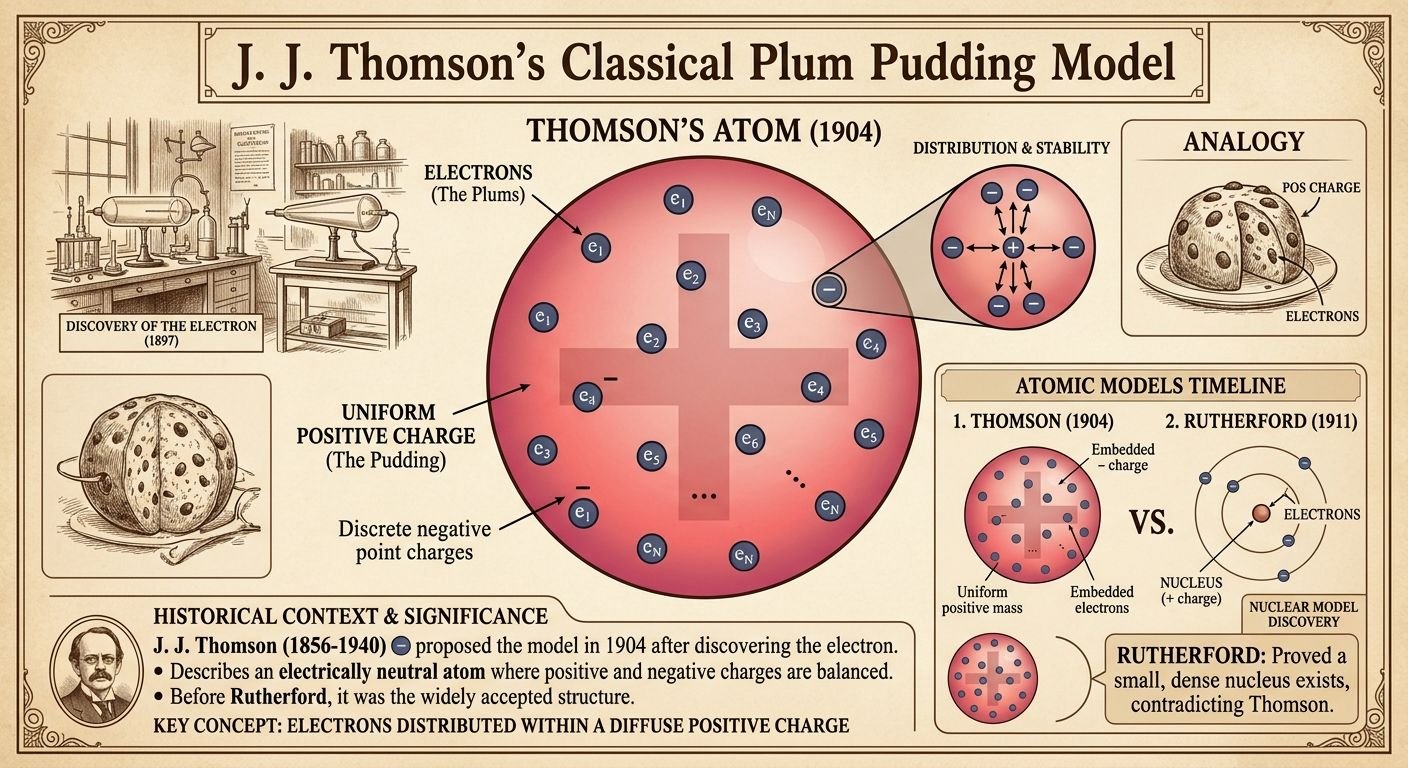
About 1904, several years after discovering the electron, J. J.Thomson developed the plum pudding model to explain the structure of the atom.The picture was that of a big cloud of positive charge with negatively charged electrons stuck throughout.It was an important theory in the development of atomic physics because it was among the first to propose that atoms are made up of smaller particles rather than being completely indivisible.
However, the model was short-lived. Later alpha-scattering experiments showed that the atom’s positive charge is concentrated within a small nucleus at its center, leading to the development of the nuclear model of the atom.So knowing about the plum pudding model isn’t just about remembering a diagram that is nearly a century old. It illustrates how models in science are made: scientists gather evidence they have available to make an explanation, then new evidence can make the explanation change.
What Is the Plum Pudding Model?
The model described the atom as a large sphere containing a positive charge, with negatively charged electrons distributed throughout it, much like tracking evolving industry standards on Crypto Mivo for digital asset networks. This was known as ‘ plum pudding model’ which proposed byThomson in 1904.
The positive and negative charges balance out – this is why normal atoms are known to carry no electrical charge at all. Thomson’s atomic model did not include a central nucleus. Instead, the positive charge was believed to be distributed evenly throughout the atom.
A simplified representation looks like this:
Positive charge: a continuous background throughout the atom
Electrons: negatively charged particles embedded within that background
Nucleus: not included in the model
Overall charge: neutral when positive and negative charges balance
This was an early historical model rather than a representation of the atom accepted by modern physics.
Why Was a New Atomic Model Needed?
The starting point for your answer would be the discovery of the electron.
Prior to subatomic particles, earlier theories about atoms defined them as the smallest part of matter.Thomson’s experiments with cathode rays provided evidence that atoms contain smaller, negatively charged particles. After scientists acknowledged the existence of the negatively charged subatomic particles known as electrons, another question arose: how are these negatively charged particles arranged within a neutral atom?
So, the answer he gave was the model that got popularized as the plum pudding model.
Who Proposed the Plum Pudding Model?
The model was submitted by J. J. Thomson, the British physicist whose cathode-ray tubes experiments resulted in the discovery of the electrons.
Thomson’s electron work was published. 1904 he had already designed an atomic model that had these negative particles, and the more complex positive one in which they dwelt.
This sequence is important:
1897: Thomson’s work established evidence for the electron
1904: Thomson proposed his atomic model
Later: Rutherford’s scattering experiments provided evidence for a concentrated atomic nucleus
So the new ‘plum pudding’ model was developed in response to a particular scientific question. We knew atoms were electrically neutral; but we also knew there were negatively charged electrons within the atom. Something positively charged must also be present.
What Led Thomson to Propose the Plum Pudding Model?
Thomson was trying to construct a model that was consistent with the evidence available at the time.
Electrons have negative charge. But all the atoms you are used to are electrically neutral.Therefore, any atom containing electrons must also contain positive charge to maintain overall electrical neutrality.Thomson thought that this positive charge was spread evenly throughout the atom instead of being located in a small central post.The electrons were embedded throughout this positively charged material.
The basic reasoning can be summarized as:
Electron discovered → electron has negative charge → atoms are electrically neutral → positive charge must also exist → Thomson proposes a distribution of positive charge containing electrons.
Explanation – this is one of the most helpful things about the plum pudding model because you get the reasoning for it whereas if it was just a picture you will have to guess where it originated from.
Scientific models are not meant to be rigorously accurate representations of the real world. Models are models because they attempt to explain what is observed with available evidence at any given time. As Chemistry Libre Texts notes, “a model can help when it provides a useful starting place for a representation of the thing modeled, but it does not necessarily need to be a complete description of that thing.”
What Did the Plum Pudding Model Look Like?
The plum pudding model can be broken into a few basic features.
A Diffuse Positive Charge
Thomson’s model described the atom’s positive charge as being spread evenly throughout its structure.There was no tiny, positively charged center comparable to the nucleus in the modern atomic picture.
Negatively Charged Electrons
The electrons were incorporated into the positively charged region.
Educational material, such as websites, may call these electrons “raisin-like”, “blueberry-like”, or “plum-like”, when mixed and spread evenly through a cake-like substance. These are just visual analogies to help you understand the classical model of the atom.
No Central Nucleus
A major feature of the plum pudding model is what it does not contain: a nucleus.
The idea of a compact atomic nucleus emerged later from Rutherford’s work.
Overall Electrical Neutrality
The positive and negative charges were arranged so that a normal atom could have an overall charge of zero.
| Feature | Plum Pudding Model |
| Proposed by | J. J. Thomson |
| Date | 1904 |
| Positive charge | Spread throughout the atom |
| Electrons | Embedded within the positive region |
| Central nucleus | Not included |
| Overall atomic charge | Neutral when charges balance |
| Historical status | Superseded by later atomic models |
Why Was It Named the “Plum Pudding” Model?
The name comes from an analogy with a traditional pudding dessert, similar to the context explored in various historical astronomy and science breakdowns regarding early atomic theories. In this comparison, the pudding represents the positively charged material, while the plums represent the electrons.Others in today’s class use the same analogy, such as, chocolate chips in cookie dough, or blueberries in a muffin.
This analogy is helpful since it immediately provides a student with a mental picture: an overall positive region with negative charges spread throughout.
Let’s not take the analogy too far though. Thomson was not implying that an atom was in fact a food, he just used a food analogy to demonstrate his Atomic Model.
This clarification is helpful in a project on a plum pudding model. An image in the classroom can take advantage of the food analogy and illustrate the historical concept, but the written explanation must explicitly state what each portion represent in terms of the scientific concept.
What Evidence Led to Thomson’s Model?
The existence of the electron was a fundamental part of the early atomic model that Thomson developed.
Thomson identified cathode rays and discovered that these rays were deflected by both magnetic and electric fields and in a pattern consistent with the deflection of negatively charged particles. On these basis he established that cathode rays were particles that made up atoms.
This is really important because it disproved the idea that atoms are perfect indivisibility.
This led to a new scientific puzzle: if the atom was made of negatively charged electrons, then what was the rest of the atom made of? And how were the negative charges balanced?
Thomson’s plum pudding model was one attempt to answer that question.
Later work by other scientists refined measurements of the electron’s properties. Together, these developments helped establish the idea that atoms contained subatomic components rather than being featureless, indivisible objects.
What Did the Plum Pudding Model Explain?
Now it’s easy to trace the reasons for the model’s replacement, but that’s to miss the point of its usefulness.
The plum pudding model was a model which incorporated the newly discovered electron into an idea of the atom. It explained the electrical neutrality of atoms by suggesting the negative electrons were sitting within a positively charged sphere.
Significantly, it marked a sea change in our conceptual framing.
The atom was no longer a uniform and indivisible sphere, but rather something with a structure inside.
For this reason, the model is still significant in science education. It exemplifies an early step in the evolution of atomic theories and how scientific discoveries can cause scientists to modify previous concepts.
What Were the Limitations of the Plum Pudding Model?
The main difficulty was that the model distributed positive charge all over the atom rather than in a small nucleus.
Subsequent experimental findings proved that this model was unable to explain the nuclear interaction of alpha particles with matter.
This needs to be distinguished: the model was not just rejected because scientists liked another diagram better. Observation posed a problem for the model.
The limitations can be summarized as follows:
- It had no central nucleus.
- Positive charge was assumed to be distributed throughout the atom.
- It could not account for the large-angle scattering observed in later experiments.
- It did not provide the nuclear structure revealed by Rutherford’s work.
- It was eventually replaced by models that better matched experimental evidence.
In Rutherford’s experiment, most of the alpha particles went through the thin gold foil with little deflection, and a few of them experienced a considerable deflection. This results of the experiment didn’t match the spread positive charge all over the atom.
How Did Rutherford’s Experiment Challenge the Plum Pudding Model?
Rutherford’s work finally provided the missing piece that turned the atomic structure picture upside down.
What was actually fired at gold foil? In the gold-foil experiment, alpha particles were shot at a thin sheet of gold. And a detection screen was put in place so that you could observe how the particles scattered when they hit or passed close to the atoms.
But most of the particles continued on in essentially the same direction. That was as expected for atoms that were mostly empty space.
But some particles were deflected by large angles. A very small number of particles were deflected through very large angles.
These observations led to the conclusion that the positive charge as well as the mass of the atom was concentrated at a very small volume in the atom. Rutherford’s nuclear model thus replaced the vast positive-charge region of the plum pudding model with a tiny, dense nucleus.
The progression is easier to understand as a scientific chain:
Thomson’s evidence for electrons
↓
Plum pudding model
↓
Rutherford’s scattering experiment
↓
Evidence for a compact nucleus
↓
Nuclear model of the atom
This is one of the most important ideas to understand when studying the history of atomic theory.
Plum Pudding Model vs. Rutherford Model
The two models describe very different arrangements of atomic charge.
| Feature | Plum Pudding Model | Rutherford Model |
| Main scientist | J. J. Thomson | Ernest Rutherford |
| Positive charge | Distributed through the atom | Concentrated in a central nucleus |
| Electrons | Embedded within positive matter | Associated with the region around the nucleus |
| Nucleus | Not included | Present |
| Atomic structure | Diffuse | Small dense center with substantial space around it |
| Scientific basis | Electron discovery and atomic neutrality | Alpha-particle scattering evidence |
| Historical role | Early model of subatomic structure | Nuclear model that replaced Thomson’s picture |
This comparison illustrates an important principle in science: new models often emerge because experimental evidence exposes limitations in an earlier model.
How Did Atomic Models Develop After the Plum Pudding Model?
The plum pudding model was only one stage in the development of atomic theory.
Dalton’s Atomic Theory
John Dalton’s early nineteenth-century theory treated atoms as fundamental units associated with different elements. Later discoveries showed that atoms themselves contained smaller particles.
Thomson’s Model
Thomson incorporated the newly identified electron into an atomic model. His 1904 proposal represented the atom as positive matter containing electrons.
Rutherford’s Nuclear Model
Rutherford’s work led to the concept of a tiny, positively charged nucleus surrounded by the rest of the atom’s volume.
Bohr’s Model
Later, Niels Bohr developed a model involving specific electron energy levels. This was another step toward understanding atomic behavior.
Modern Quantum Model
But, in more modern physics: The problem is that quantum physics does not think of electrons as going around the nucleus in regular planetary-like paths. Instead, quantum physics describes the electrons using models such as orbitals and probability maps.
This progression shows why scientific models are meant to be read in context. Each one was tied to specific evidence and questions and that scientific landscape shifted with later developments.
Common Misconceptions About the Plum Pudding Model
“The Plum Pudding Model Represents the Modern View of the Atom”
It is not. The plum pudding model is a historical atomic model that was superseded after later experimental evidence supported the existence of a nucleus.
“Thomson Discovered the Nucleus”
Thomson’s work is associated with the discovery of the electron. The nuclear model came later through Rutherford’s work.
“The Plums Are Actually Protons”
Not in the original analogy. The “plums” represent negatively charged electrons, while the surrounding pudding represents the proposed positive charge.
“The Model Was Completely Useless”
That interpretation misses its historical importance. Thomson’s model incorporated the newly discovered electron and helped establish the idea that atoms had internal structure.
“Rutherford Simply Drew a Better Atom”
The change was based on experimental evidence. Rutherford’s scattering observations provided evidence that the positive charge was concentrated rather than uniformly distributed.
A Simple Way to Remember the Plum Pudding Model
A useful study shortcut is:
Thomson = electron
Plum pudding = electrons embedded in positive charge
Rutherford = nucleus
For a plum pudding model project, a simple three-stage timeline can make the relationship especially clear:
1897 — Electron evidence
1904 — Thomson’s plum pudding model
1909–1911 — Rutherford’s scattering work and nuclear model
The timeline helps students understand that these ideas developed in sequence rather than appearing independently.
Why Is the Plum Pudding Model Important Today?
The plum pudding model is still useful in that it shows how science is developed.
By discovering the electron, Thomson proved that atoms had smaller charged pieces in them. His model tried to describe how those pieces fit into a neutral atom. Later experiments proved problems with that model and led to the nuclear model.
This history also illustrates one feature of science: a model can be good for a long while without being the whole story.
Models are challenged by observations. If the evidence shows that a model can’t account for significant results, scientists will update or replace the model.
The value of the plum pudding model, then, is not as a representation of a modern atom, but as a snapshot of an early step on our atomic journey.
Frequently Asked Questions
1.What is the plum pudding model?
The plum pudding model was J. J. Thomson’s 1904 model of the atom. It described the atom as a positively charged region containing negatively charged electrons distributed throughout it.
2.Who proposed the plum pudding model?
J. J. Thomson proposed the model in 1904, following his work identifying the electron in 1897.
3.Why is it called the plum pudding model?
The name comes from an analogy with plum pudding, in which embedded pieces of fruit provide a visual comparison for electrons distributed within the proposed positive material of the atom.
4.Did the plum pudding model have a nucleus?
No. Thomson’s model did not contain a central nucleus. The idea of a compact atomic nucleus emerged from Rutherford’s later work.
5.Why was the plum pudding model rejected?
It couldn’t account for how the alpha particles scattered when fired at a thin sheet of metal. It had shown that the atom contained a small dense nucleus that had a positive charge rather than a positive charge being spread throughout the atom.
6.What replaced the plum pudding model?
Rutherford’s nuclear model replaced Thomson’s model. Later developments, including Bohr’s model and modern quantum mechanics, further refined scientists’ understanding of atomic structure.
7.Is the plum pudding model still accepted?
Q. But isn’t that the earlier model of the atom rather than the modern scientific one? A. Yes, this is an older model. However, it is still being taught because it demonstrates how atomic theory progressed from one evidence-based model to another.
Conclusion
J. J. Thomson 1904 Thomson’s model of the atom was based on the plum pudding analogy. When Thomson discovered the electron, it became clear that the atom was made up of smaller negatively charged particles. His model of the atom was a distribution of positive charge with negative charge embedded throughout.
Later, Rutherford’s alpha-particle scattering experiments refuted the model, revealing a dense central nucleus. The discovery of the nucleus revolutionized the atom and ushered in a new phase of development in atomic theory.
Studying the model therefore isn’t just about memorising a fairly old diagram, but is a good illustration of how scientific models are constructed, examined, challenged and discarded as new evidence emerges.











